


Newsroom
MR vs MRL Elevator: Complete Guide (2026)
MR and MRL elevators share the same goal but use different structures. Here's a clear, side-by-side comparison to help you choose the right system for your building.

CONIC
Published on September 7, 2026
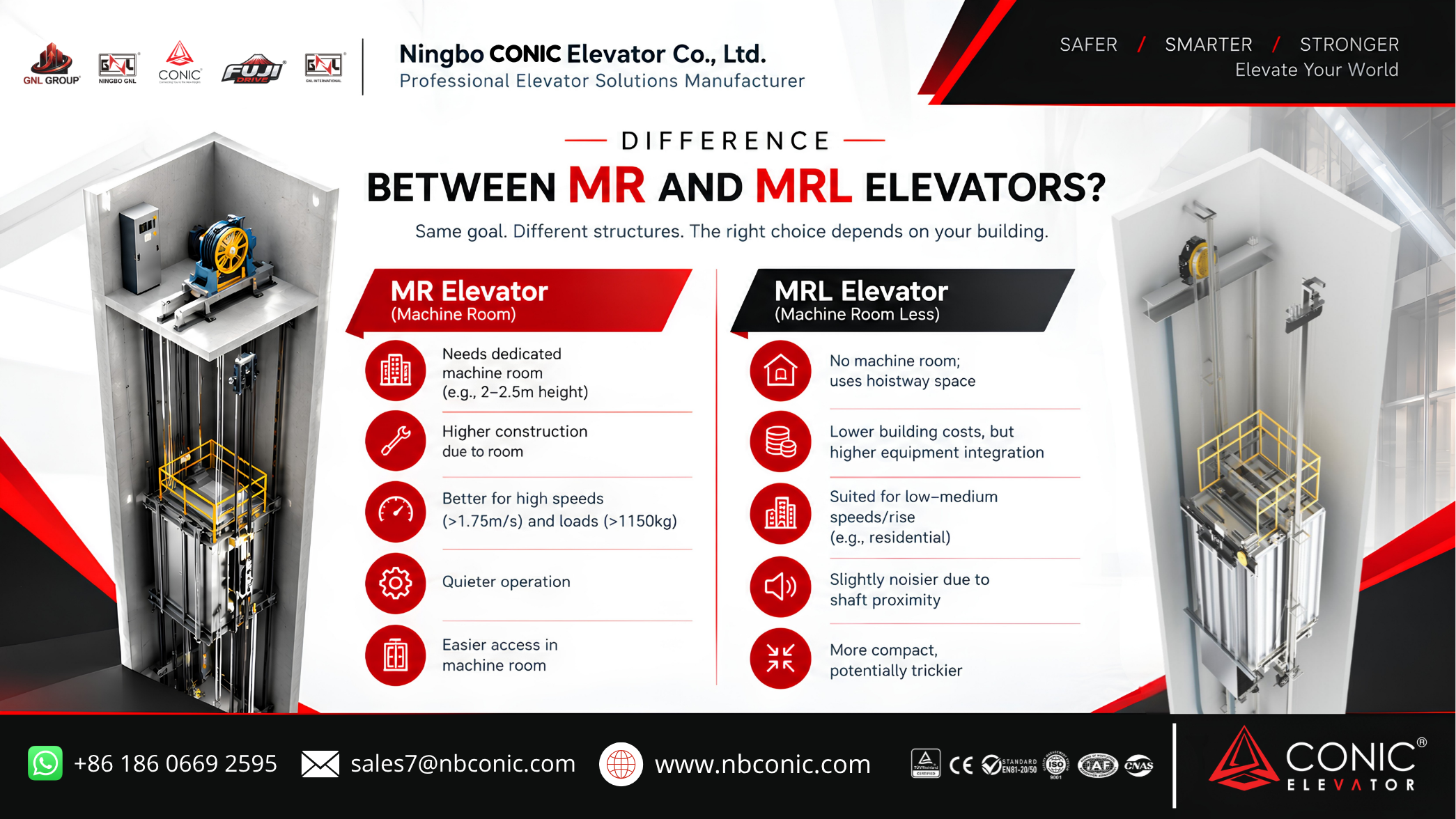
Choosing between an MR (Machine Room) elevator and an MRL (Machine Room-Less) elevator is one of the first decisions you'll face when planning a building's vertical transportation. The right choice affects your construction budget, available floor space, elevator speed, and long-term maintenance access.
This guide breaks down exactly what separates the two systems, so you can match the right elevator to your project.
What Is an MR Elevator?
An MR elevator houses its drive machine, controller, and related equipment in a dedicated machine room, usually positioned above the shaft and requiring 2–2.5 meters of extra height. This traditional structure has been the standard for decades, particularly in taller and higher-traffic buildings.
Key characteristics of MR elevators:
Requires a dedicated machine room
Higher construction cost due to the added room
Better suited for high speeds (above 1.75 m/s) and heavier loads (above 1150 kg)
Quieter cabin operation, since machinery is isolated from the shaft
Easier technician access for maintenance and repairs
MR elevators remain the preferred choice for high-rise buildings, commercial towers, and any project where speed and load capacity are the top priority.
What Is an MRL Elevator?
MRL elevators eliminate the separate machine room by integrating the drive machine and controller directly within the hoistway shaft. This saves valuable building space and reduces the civil construction work required around the shaft.
Key characteristics of MRL elevators:
No machine room — all equipment fits within the shaft
Lower construction costs, though equipment integration requires more precise engineering
Best suited for low-to-medium speeds and rise heights, such as residential buildings
Slightly noisier operation due to machinery proximity within the shaft
More compact footprint, though maintenance access can be trickier
MRL elevators have become the go-to option for residential buildings, home elevators, and low-to-mid-rise projects where space efficiency and lower upfront costs matter most.
MR vs MRL Elevator: Side-by-Side Comparison

MR: Required (2–2.5m)
MRL: Not required
Construction Cost
MR: Higher (extra room)
MRL: Lower, but more equipment integration
Best Speed Range
MR: High speed (>1.75 m/s)
MRL: Low-medium speed
Best Load Range
MR: Heavy loads (>1150 kg)
MRL: Standard residential loads
Noise Level
MR: Quieter
MRL: Slightly noisier
Maintenance Access
MR: Easier
MRL: Slightly trickier
Best For
MR: High-rises, commercial towers
MRL: Residential, low-to-mid-rise
Which One Should You Choose?
There's no single "better" option between MR and MRL elevators — the right choice depends on your building's height, traffic volume, and budget.
Choose an MR elevator if your project is a high-rise or commercial building that needs high speed, heavy load capacity, and straightforward long-term maintenance.
Choose an MRL elevator if you're working on a residential or low-to-mid-rise building where saving construction space and reducing upfront costs are the priority.
How Do I Decide Between MR and MRL for My Project?
The right choice comes down to three factors: building height, expected traffic volume, and available construction space. For buildings under roughly 10–12 floors with standard residential traffic, MRL is usually the more cost-effective option. For taller buildings or higher-speed requirements, MR remains the more reliable structural choice.
Talk to an Elevator Specialist
Choosing between MR and MRL isn't just a technical detail - it shapes your building's layout, budget, and construction timeline from the ground up. Our team can review your project's requirements and recommend the right system for your needs.
Get in touch for a free consultation and quote.
📩 info@nbconic.com 📱 WhatsApp: +86 186 0669 2595